– Useful to be somewhere where Norwegian is spoken all the time
An important part of the introduction programme for refugees in the municipality is a work placement at a workplace. Every year, between 20 and 30 participants combine work placement and language training at Folkeuniversitetet. It gives visible results.

– I have gained more confidence, learned a lot and built a bigger network in Asker, smiles Stanley Mativenga from Zimbabwe. He came to Norway in November 2021. In June he started Norwegian classes, and already in September he got a work placement at NaKuHel. After just one year in the country he speaks Norwegian very well, and believes the days of work placement are an important reason for that.
– At NaKuHel I have met many people who are interested in talking to me, and they have made it easy for me to take part. Before, I was very afraid of saying something wrong, and I was quiet a lot. Now I dare much more, he says.
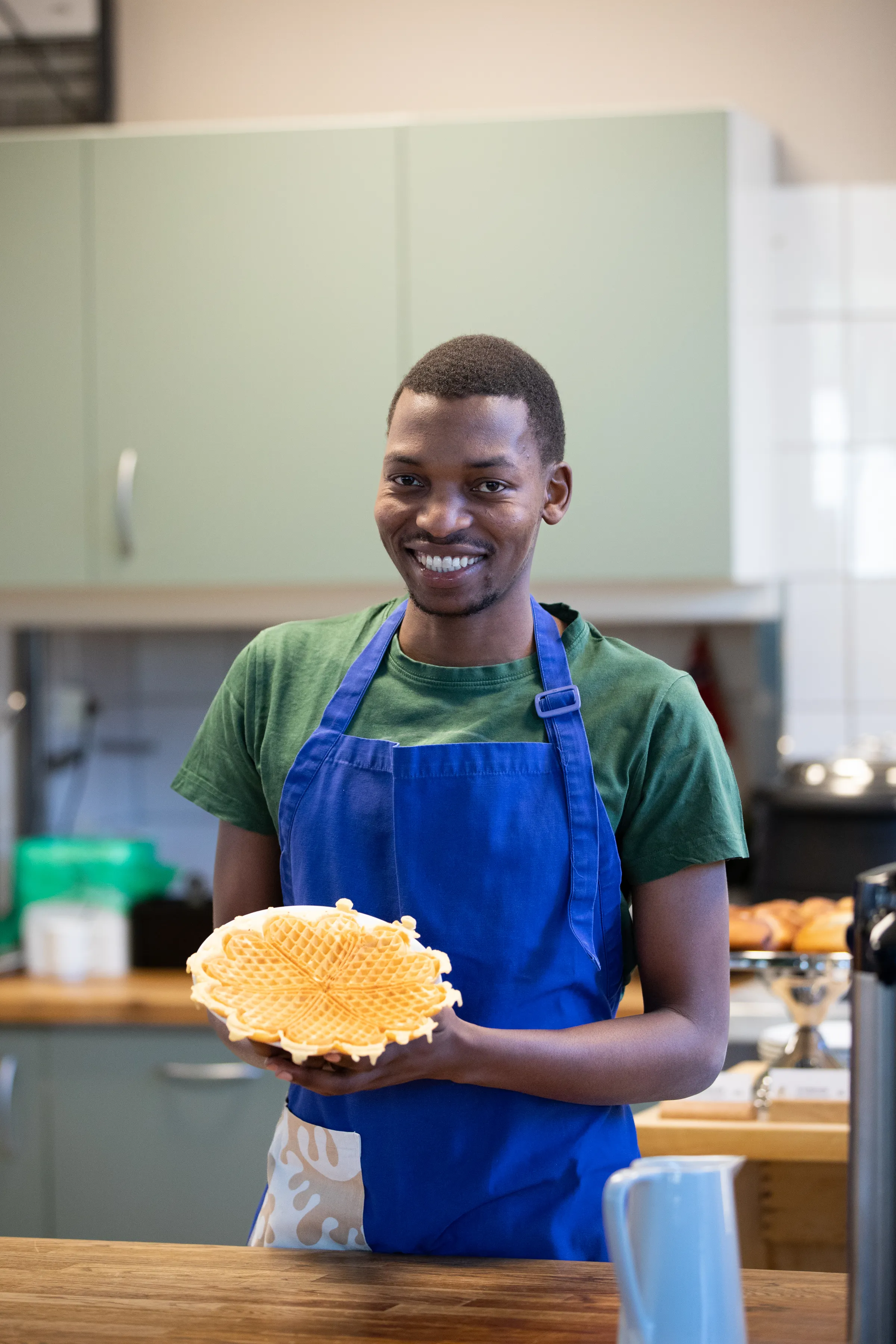
For four months he has done a work placement two days a week, taking part in both renovating a greenhouse and serving in the café. He has spent a lot of time in the kitchen and has greatly enjoyed learning to cook Norwegian food. The rest of the week he has continued language training at Folkeuniversitetet, as part of the introduction programme.
Increased motivation to learn
– A work placement is a way of learning Norwegian authentically, through real situations. Such a period often increases the motivation to learn more, says Mai Ravik, coordinator for the introduction programme at Folkeuniversitetet. The placements take place at private and municipal workplaces, and both businesses and participants have had good experiences.
– Many see the value of gaining an extra work resource while also getting the chance to give something back, she says, listing kindergartens, workshops, libraries, cafés and receptions as some of the placement sites.
NaKuHel Asker, a volunteer centre and public health actor at Sem, has had that experience too.
– Having participants here on placement is incredibly positive, both for the activity at the centre and for our volunteers, says volunteer coordinator Jorunn Marie Thon.
While the participants contribute with their work, she finds that the social environment gives them a lot in return. Among other things, a bigger network in Asker.
– We arrange a number of social activities, and see how people blossom when they feel at home. Linguistically, too, it takes them several steps further.
Network and practice
Stanley can vouch for that.
– The conversations with staff and volunteers, and what they have helped me with, were the most important part of the placement, he says. He now plays basketball at Risenga twice a week thanks to tips from here, and he celebrated Christmas Eve at NaKuHel.
– I find it is important to speak Norwegian to get to know new people in Norway. It is easier for me now.
Galavizh Fattahi has had the same experience. She is from Iran and came to Norway three years ago. After a year and a half of language training she got a placement at Heggedal innbyggertorg.
– I met incredibly kind and patient staff who included me and talked to me. An important part of the placement is being somewhere where Norwegian is spoken all the time, she says.
At the same time, Galavizh is clear that you need to know a fair amount of Norwegian before you benefit from such a period. Participants normally have at least six months of Norwegian classes first.
– For me, the social lunch breaks were the most important. At the start I had enough to do just listening to the others and understanding, but gradually I could contribute more to the conversations.
(Photo at the top of the article)
ENJOYING IT: Stanley has learned a lot of Norwegian from his work placement at NaKuHel. Here with Pupung Ratna Tunjungpuri (left), who works in the café, and volunteer Anne Furstenberg. (Photo: Simen Sjølund)
The introduction programme
Newly arrived refugees who are settled in Asker municipality have the right and duty to take part in an introduction programme, which provides an introduction to Norwegian, social studies and working life.
- This is a full-day programme (37.5 hours a week), and its length varies depending on previous schooling.
- The aim is to strengthen each person's financial independence and help them into work or education when the programme is finished.
- Part of the programme is a work placement at a workplace.
- Teaching takes place at the introduction centres in Asker centre, at Folkeuniversitetet and at the introduction centre at Filtvet.
ASKER'S BEST: – The waffles here are the best, says Stanley, who has greatly enjoyed learning to cook Norwegian food. (Photo: Simen Sjølund)
Text: Marit AsheimPhoto: Simen Sjølund